The HiFi Mai Tai Beach Bar is a long way from anywhere. It can take a while for the rest of the world to reach us here. But that’s just the way we like it. This is meant to be a paradise removed from the troubles of the world. It does mean though that we can be a bit late to the party (hopefully fashionably late) and this is exactly what has happened with the Juzear Nimbus. Reviews of this IEM where every where a few months back but its only now that the HiFi Mai Tai Beach bar is ready to accept the Nimbus and in doing so welcome a cloud to our usually cloud free getaway. Hopefully we won’t regret it. Hopefully the rain is not here to stay. But lets find out. Lets get to the Bartender’s Juzear Nimbus Review.
Juzear Nimbus Review – The Cocktail:
The Juzear Nimbus is a single dynamic driver IEM. We haven’t had one of those for a while (Actually that’s not true. We have had loads). Typically priced around the £50 mark this IEM is firmly targeting the budget range rather than the ultra budget however I paid only £26 to get this IEM (a pretty pleasing deal). The difference in these prices is important to consider through this review (I won’t say anymore).
For a single dynamic driver the specs are very typical. And I always like it when IEM brands brag about the materials of their drivers. Not sure I believe their bold claims (I don’t) but I do enjoy knowing. In this case it’s a 10mm multi-layered amorphous carbon composite diaphragm. Sounds impressive but it probably could be described as a 10mm pencil or a 10mm diamond (and there is a pretty big difference between those two). I am definitely not the right person to explain this (I am only a bartender after all) but its my understanding that a multilayered amorphous carbon structure would actually be somewhere between graphite and diamond with the structure including both the graphite and diamond bonds. I just mix the drinks.
Its also always a bit of a red flag to me to see the phrase ‘Self Developed’. To me its bit like the phrase ‘handmade’ or ‘made in Britain’. Some things are just better when they are handmade but these are usually things that don’t have to do anything. If you want something to sit there and look pretty then handmade is the best but if you want to use it, if you want it work then I would rather have the highly refined precision machine made and tested rigorously option. Handmade paintings are great but a handmade toaster would be a pain. Maybe IEMs are somewhere between a toaster and a painting. Isn’t that a strange thought.
- Drivers:Single self-developed 10mm MACCD (Multi-Layered Amorphous Carbon Composite Diaphragm) dynamic driver
- Frequency: 20 to 20,000 Hz
- Impedence: 132Ω
- Sensitivity: 108 dB/mW
Juzear Nimbus Review – The Taste Test Setup:
I should start this section with a bit of a confession. I unboxed the Juzear Nimbus and got to straight to listening. I didn’t realise that the different tuning nozzles. Therefore, I haven’t actually tried any of the other two pairs of nozzles. I have used only the default white nozzles. The included black nozzles are intended to boost the bass and the red nozzles deliver more treble. I have no idea how effective these nozzles but just know that if you want a little more of either end it should be possible.
Also, side note, we should definitely all just agree a colour scheme for tuning nozzles. Red for treble, yellow for bass and green for neutral or something. It’s a wild west out there at the moment. Its time to bring some sort of order. The nozzle colour sheriff is in town.
For this review I used the stock eartips. These tips are nothing special but they worked well. Perhaps almost as importantly the colour of these tips match the design of the IEM really well. The sheriff is ready to recruit whoever picked this colour as their deputy. Good job.
- DAC/AMP: SMLS M20
- Cable: 4.4 mm Tripowin C-01
- Eartips: Stock (Silicon)
Juzear Nimbus Review – The Non-Audio:
Okay the non-audio. Accessorises first. Well, I rated the accessory package lowly but maybe that was a little harsh (I had forgotten about the nozzles after all). For an ~£25 IEM the cable is excellent but for a £50 its much more as expected. Whilst its not a fashion disaster the stock cable is not as good a colour match as the Tripowin C-01 I used (when did I start to care about this stuff so much). Anyway to summarize, perhaps it was deserving of a higher rating but what’s done is done and we should move on.
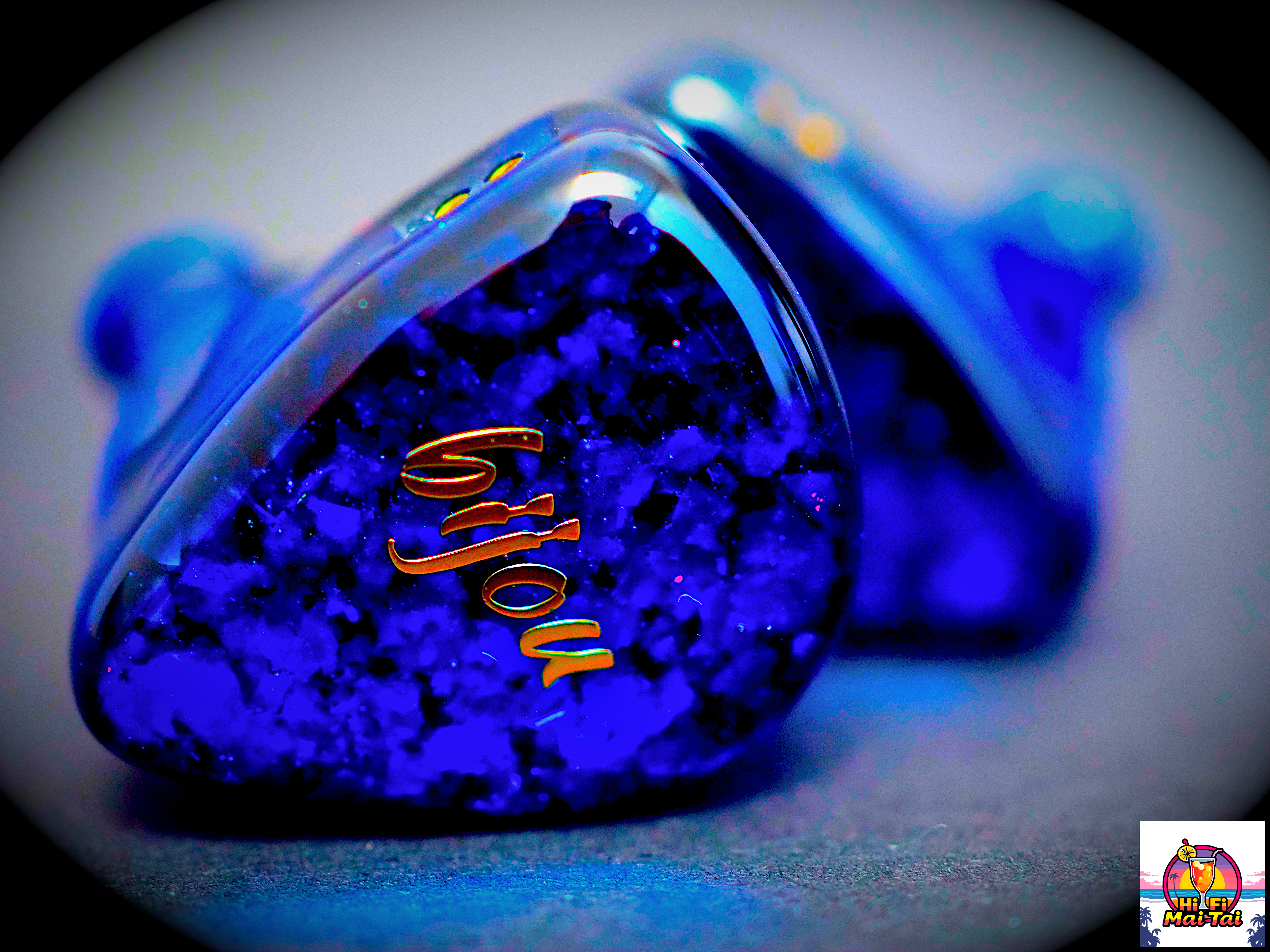
Move on to the build. Juzear have earnt a bit of a reputation for ‘relaxed’ quality control. I little bit of it will do attitude. The join of the faceplate to the rest of the shell is pretty massive. Could probably get a crowbar in there. And the gap between the blue panel and the rest of the faceplate section is not much smaller. All that said these are a solid metal build (with a glass cover I think). During testing I had no problems and whilst I don’t think these are ready for war they probably are ready for the morning commute.
Despite being an all metal build, these are not particularly heavy. They are reasonably small perhaps not small enough to be a small ear specialist but small enough to unassuming. I certainly never find myself marvel at their size (big or small) unlike some other IEMs (KZ Decet or Aurora Ultra any one?).
And finally style. This is an interesting one for me. I have generally preferred bold, colourful IEM designs. I want to see the fun and the madness across the shells. I don’t want grey. I am not looking for a work suit. But, and it’s a big but, I quite like the look of these. The shiny metal and blue faceplate for some reason give me rocket vibes. A certain 1980s era blue Lego astronaut (Benny) would probably approve of this design and that’s good enough for me.

Juzear Nimbus Review – The Audio:
Entering Audio Orbit. First stop the bass. My initial thoughts were that the bass is really clean. That it really prioritises speed and clarity over thickness and rumble. However, with further listening I just had to conclude that this is just a really good bass. It is pretty clean but this is really just the result of it being well controlled. The slam and hit is decent, you can feel it, but its not just a hit as there is some depth and body. But equally its not all subbass it isn’t soft and wobbly. This is a bass that has been hitting the exercise bike and has the toning to show for it. Its pace and power but also precision.
As I mentioned previously I did not try the bass boosting nozzle but I suspect this won’t change things much. Therefore, the Nimbus is probably not the IEM for a hardcore bass hit. Other IEMs have more texture and rumble and other IEMs can hit harder. However, for most people (the bass moderates of the world) this bass is sure to please.
The mids retain good clarity and good tonality. There is no great warmth here but there is enough weight not to sound thin. There is also no great brightness but there is enough to sound clear and sharp. Again, like the bass, the mids are a very balanced sound. To be really picky I would suggest that some lower end instruments were a little thin but this was not consistent across my testing playlist and may result from the recording of the track and not the IEMs. So yeah I am going balanced. Balance is the word of the day (welcome pack to primary school).
And this balance continues into the treble which has air and has sparkle but is not sharp or harsh. There is good energy in this treble that adds focus to the sound and balances the controlled energetic bass. Some might find this a little too much treble as there are definitely peaks in the treble but for me they were never too much and I would probably miss the sound if very weren’t there.
Vocals generally had a pretty neutral position. Perhaps sometimes they were a little further forward than normal but not enough to really highlight anything. I certainly didn’t feel like I was being shouted at. A quick peak at some online graphs suggest that the red nozzles might enhance the vocals quite a bit probably pushing them a little further forward. So if you are a vocal lover these might just deliver but I am afraid you must seek the opinion of another bartender (or IEM reviewer) for that information. I told you I only pour the drinks.
Being generally a very balanced sound I felt that male and female vocals were equally presented. For vocals (and generally) the Nimbus is not a specialised tuning. Its very balanced (did I mention that already). These are good for a variety of music and for general listening and I think this is probably what they were going for with the tuning.
And finally the technicals. The energy in the treble helps sharpen treble details whilst the controlled bass lets the mids breath. The result is an overall detailed sound with good imaging and pretty good layering. These are not technical monsters. They aren’t cold or analytical they are still very musical but they aren’t missing anything. The little sounds are all there. The little things that matter so much. It is after all all about the little things in life.
The soundstage is not huge. The good imaging and good layering allow for a smaller soundstage that remains function. Some how the whole orchestra has been crammed into a mini and none of the music has been lost. If you prefer slightly more intimate sound stages then at this price range this is a pretty good option but equally there are other options with even smaller soundstages (probably a bit too small).

Juzear Nimbus Review – The AI Opinion:
In this section I have asked Copilot (sorry the last few were also Copilot not Google and I failed to update this text) mode to predict a score for the to be reviewed IEM prior to publishing my review. To get this prediction I have asked that it predict a score based upon the scoring system employed by me here at the HiFi Mai Tai beach bar. That’s it. It is as simple as that. I could be doing myself out of the job here. But got to embrace the modern world etc. And if AI is gonna take my job I am going to go down fighting. Hopefully it proves itself rubbish and there is nothing to worry about.
So the Nimbus. What does AI think?

Hmm well we agree on the technicals and the details. But that’s it. Nothing else. I imagine this is very much the sort of difference in opinion that most peace talks start with. No surprise really that they never seem to work (shame). Well when the peace talks between the human race and AI begin you should probably pick someone other than me as the negotiator as its already well proven that AI and I just do not agree. We are just too different. And for that I am grateful imagine thinking every little think is so important it would be exhausting. I could not cope with having to use weasel wording and AI hyperbole every time I spoke. Nope count me out.
Juzear Nimbus Review – Comparisons
Okay lets kick things off with the KZ DQS. The KZ DQS is an older single dynamic driver IEM for which I paid £19 though it is probably available for a lot less (if it even is available). I thought this comparison might be a good idea as someone who has lived with the KZ DQS and is looking for an upgrade but values the cohesive sound of a single dynamic driver may well be considering the Juzear Nimbus.
So how do they compare? From a non-audio perspective the Juzear Nimbus is clearly worth the extra money. I do kinda like how the KZ DQS looks but the Nimbus is much cleaner and sharper. Combine this style with a metal build and the Nimbus is undoubtedly the premium option. It’s a similar story with the sound as well. The bass of the KZ DQS has more bounce and hits a little harder but the Nimbus is more refined and shaped. The mids of the DQS are much thinner and more recessed. The vocals of the DQS are also thinner, this does give a nice sharpness to female vocals but can also result in a harshness. The treble is also harsher, sometimes a little too harsh. The sound stage of the DQS is smaller and it doesn’t match the technical performance of the Nimbus. If bass is all you care about then the DQS is a good option but really when considering audio as whole its an easy win for the Juzear Nimbus.
Okay moving on. The Moondrop Chu II next. The Moondrop Chu II is a single dynamic driver IEM for which I paid just £11. But that was a good deal and its generally closer to £20. Though that was before the Moondrop Chu III released so perhaps the Chu II is even cheaper these days (perhaps?).
Anyway on the comparison. These are both all metal constructions which is nice. The Moondrop Chu II are tiny so if you are cursed with tiny ears then these may be the better option regardless of audio performance. When it comes to audio performance these two aren’t a million miles apart. The bass is pretty similar with the tuning but the Nimbus has much more of it and it sounds fuller. I like bass a lot so this is a big win for the Nimbus. The mids and vocals are fairly similar with both balancing weight and clarity. The Chu II mids are maybe a touch more recessed and thinner and the Nimbus has slightly further forward vocals. The Chu II does have slightly brighter vocals which is good for female vocals and not so good for male though neither IEM is particularly specialist. There is a little more harshness in the Chu II with the Nimbus delivering its detailed sound more effortlessly. Overall I would take the Nimbus but if considering the Nimbus as a £50 IEM and the Moondrop Chu II as £10-£20 it is harder to justify the price. Of course you could just get the Nimbus on a good sale (as I did) then justifying the difference in price is much easier.
And finally the Tangzu Waner Red Lion. Yes I know I still haven’t redone the review of this IEM with TRN T-tips. It has been on my to do list for a while. I will get to it. But for now the Red Lion shall just have to be satisfied with a review that rates it pretty poorly and comparisons that sing its praises. The Red Lion is a single dynamic driver for which I paid £21. It has recently been replaced by the purple something (I forgot what) so it might be available for even less.
The build of the Red Lion is budget. The red colour is perfectly alright but overall it looks cheap and very plastically. It also feels brittle. It’s another undisputable non-audio win for the Nimbus. The vocals of the Red Lion are much further forward pulling the soundstage in resulting in an intimate presentation. The technical performance of the Nimbus is better with the imaging and layering all improved over the Red Lion resulting in much better instrument separation. The red lion bass is also leaner than the Nimbus. Its hits just as hard but has less depth and less body than the Nimbus. If you really are all about vocals then the Red Lion might be the better option particularly if you like the vocalist to be up in your face like a drunk man trying to start a fight. But the Nimbus is a better all-round option and personally the vocal position of the Red Lion is a little too much for me.

Juzear Nimbus Review – Overall
If considering this a £50 IEM then the Juzear Nimbus is a pretty good option. If considering this a £25 IEM there arean’t too many other options. In a competitive single dynamic driver market at either of these price point the Juzear Nimbus holds its own. Is it the one you should get? Well as a complete package is better than anything similar that has been tested at the beach bar. And if only considering the Audio? Well its still basically better. More complex driver arrangements at this price point do provide steep competition but if you just have to have a single dynamic driver then may this is the one.

Score: 77.23 %
The House Special